
A fire alarm system does one job that matters above all others: it gives people time. Time to leave the building, time for responders to arrive, time for doors to close and fans to stop feeding smoke. Everything about design, installation and maintenance should be judged by whether it protects that time.
This guide is for owners, consultants and facility managers in Kuwait. It explains how fire detection and alarm systems work, how to choose between conventional and addressable technology, what to expect during approval and testing, and how to keep a system reliable after handover. Our fire alarm systems service page lists what we deliver.
What a fire alarm system includes
A fire detection and alarm system is a group of devices connected to a control panel.
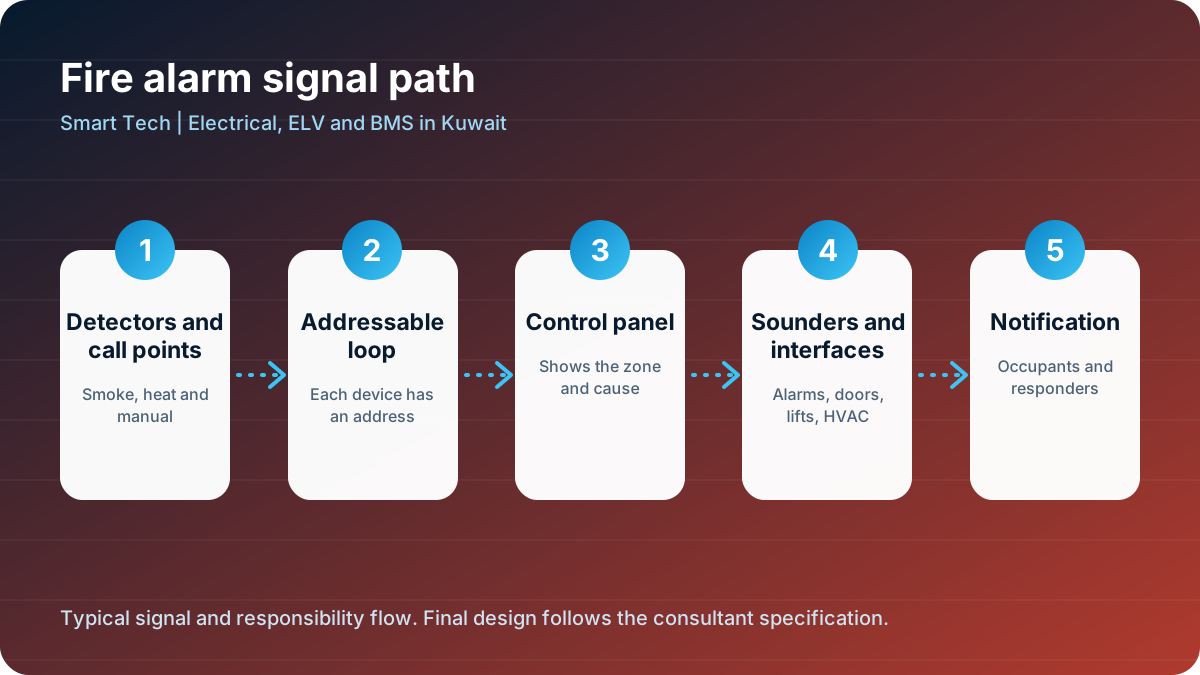
- Detectors sense smoke, heat or flame. Smoke detectors can be optical, ionisation or multi-criteria, while heat detectors react to temperature rise.
- Manual call points let people raise the alarm by breaking glass or pressing a button.
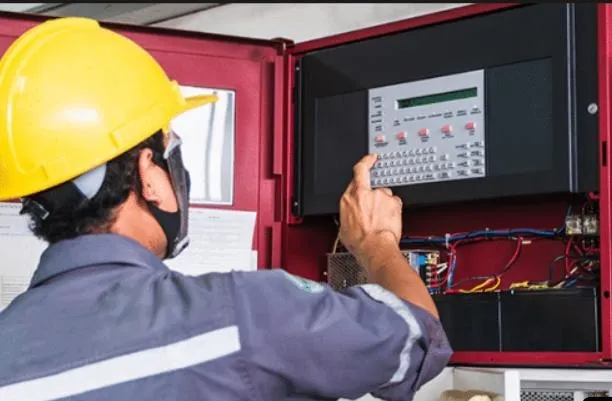
- Control panel receives signals, shows the location and cause and operates outputs.
- Sounders, beacons and voice systems alert occupants. See our article on public address and voice evacuation.
- Interfaces release magnetic door holders, stop air handling units, return lifts to the ground floor, unlock doors and signal the building management system.
- Power supply with batteries that keep the system working if mains power fails.
The basic principles are summarised on Wikipedia's fire alarm system page, and the major design standards come from organisations such as the National Fire Protection Association and the British Standards Institution. Many European projects also refer to the EN 54 product standards for components.
Conventional systems: simple and economical
In a conventional system the building is divided into zones, for example one zone per floor or per wing. All detectors in a zone share a pair of wires. When a detector activates, the panel lights the zone indicator. Someone must then search the zone to find which device caused the alarm.
Advantages: Lower cost, simple technology, easy for small premises.
Limitations: Location accuracy is limited to the zone, wiring grows quickly in larger buildings, fault finding takes longer and the system offers fewer features.
Conventional systems suit small shops, small offices and simple single-storey buildings.
Addressable systems: precise and flexible
An addressable system connects devices on a loop of cable. Every device has a unique address, so the panel reports the exact detector or call point and its location text, for example Floor 3, Corridor East, Detector 14. The panel can also monitor the condition of each detector, such as how dirty it is.
Advantages: Precise location, easier maintenance, fewer cables, programmable logic, better reporting, ability to integrate with other systems.
Limitations: Higher cost of devices and panels, need for specialist programming and commissioning.
Addressable systems are the usual choice for multi-storey buildings, hotels, malls, schools, hospitals and any site where speed of response matters.
| Feature | Conventional | Addressable |
|---|---|---|
| Location of alarm | Zone | Individual device |
| Cabling | Per zone | Loop |
| Fault finding | Slower | Faster, device level |
| Cost | Lower | Higher |
| Best for | Small simple premises | Medium and large buildings |
Choosing the right detector for the space
The wrong detector in the right place causes false alarms. Match the detector to the environment.
- Optical smoke detectors respond well to slow smouldering fires and are common in offices, corridors and bedrooms.
- Heat detectors suit kitchens, boiler rooms, car parks and dusty areas where smoke detectors would trigger falsely.
- Multi-sensor detectors combine smoke and heat sensing to reduce false alarms in difficult areas.
- Beam detectors cover tall open spaces such as atriums and warehouses.
- Aspirating systems sample air through pipes and provide very early warning in server rooms and high-value spaces.
- Flame detectors are used in industrial areas and fuel handling.
In Kuwait, dust is a significant factor. Outdoor-adjacent areas, car parks and industrial buildings should use detectors designed for dusty environments, and maintenance should include regular cleaning.
Design basics that matter
Zoning and addressing
Divide the building logically. Fire zones usually follow fire compartments, stairwells and floors. Clear naming helps responders and maintenance technicians.
Cable and containment
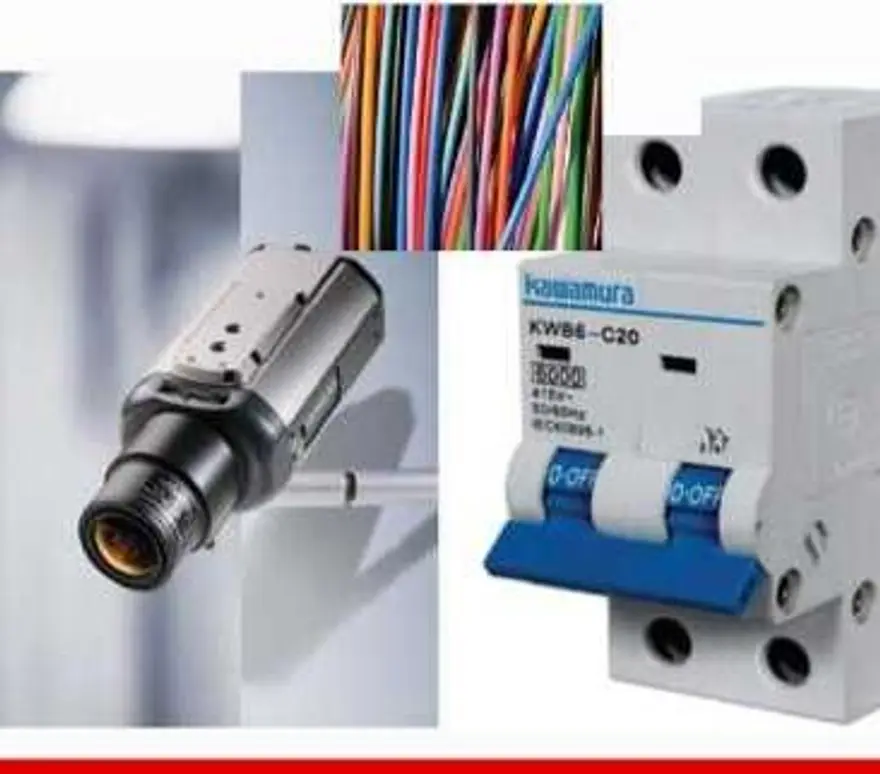
Life-safety circuits normally use fire-resistant cable on supports that will survive a fire for the required time. Cable routes should avoid areas where fire risk is highest, and they should be separate from power cables. Correct cable selection and installation are major parts of the system's reliability.
Cause and effect
The cause and effect matrix lists what happens when each type of device activates. It might say that an alarm in the kitchen starts sounders on that floor, shuts the kitchen extract fan, releases door holders and alerts the fire panel in the main lobby. Writing this down early prevents misunderstandings during commissioning.
Power and standby
Panels and sounders need battery backup sized for the required standby time plus alarm time, with allowance for battery ageing. A common failure at inspection is a battery that no longer holds its capacity.
Integration
Fire alarms often interact with lifts, access control, HVAC and the building management system. Interfaces for life-safety functions should use dedicated, monitored circuits and not depend on a shared network.
Approvals, inspection and documentation in Kuwait
Fire safety systems are subject to review and inspection by the competent fire authority. The process usually includes submitting drawings and material data for approval before installation, then inspection and a witnessed test at completion. Requirements can differ by building type and may change, so your consultant and contractor should confirm the current rules at the start of the project.
Prepare the following documents early:
- Fire alarm layout drawings and riser diagram.
- Material submittals with data sheets for every device.
- Battery and power calculations.
- Cause and effect matrix.
- Test procedures and certificates.
- Operation and maintenance manuals.
Experience shows that most delays come from late or incomplete submittals, not from the physical installation.
Installation: practical points
- Install after ceilings are ready, but pull cable early in the project.
- Protect detectors during construction. Dust from sanding and cutting causes false alarms. Detectors should be covered, and the covers removed only when the area is clean.
- Test cable before connecting devices, including loop resistance and insulation.
- Label panels and devices clearly to match drawings.
- Seal penetrations through fire-rated walls and floors with approved fire stopping.
Testing and commissioning
Commissioning proves that every device works and every programmed action happens. A typical sequence is:
- Visual inspection and cable tests.
- Power-up of the panel and loop verification.
- Device-by-device functional tests with smoke or heat test equipment and call point activation.
- Cause and effect tests with all connected systems, such as lifts and doors.
- Battery and standby tests.
- Witnessed acceptance test with the consultant and authority.
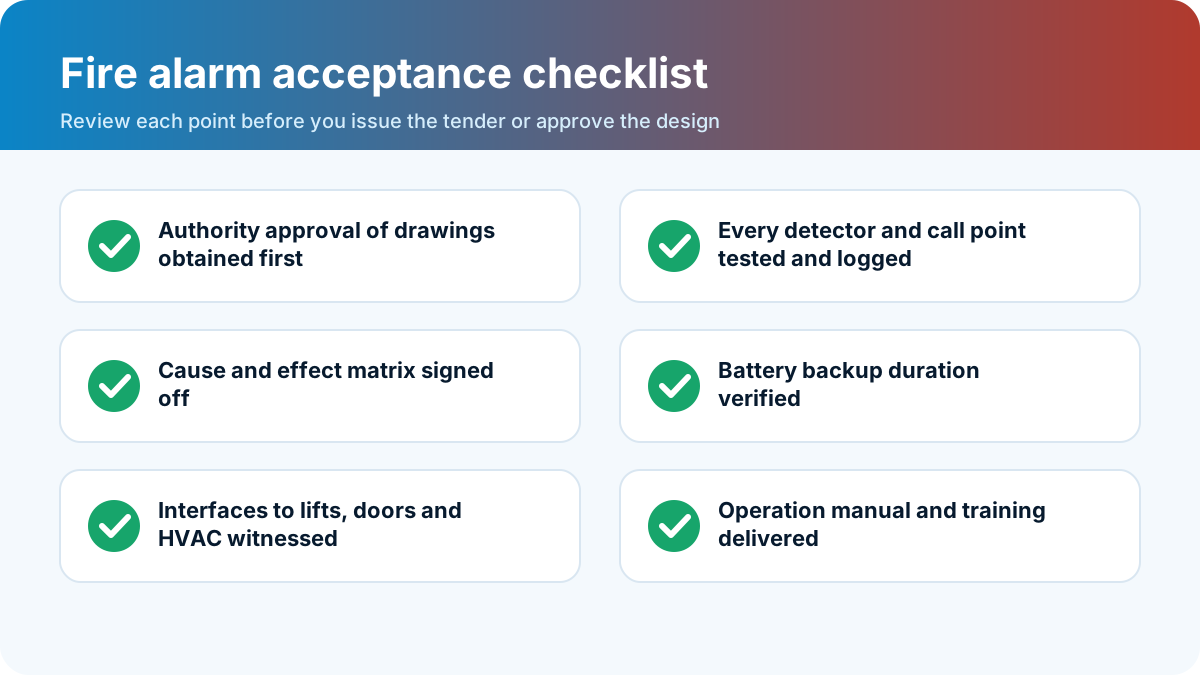
Our broader approach to testing is described in testing, commissioning and maintenance.
Maintenance routine
A fire alarm system is only as good as its last test. A practical routine includes:
- Weekly: operate one manual call point on a rotating basis and confirm that the panel responds. Record the result.
- Monthly: check panel indications, fault logs and sounder operation.
- Quarterly: test a sample of detectors, check batteries and verify the interfaces.
- Annually: test all devices, clean detectors, test batteries under load and review the system with a competent engineer.
Keep a logbook. It is evidence for authorities and insurers and it helps technicians diagnose repeated faults.
Preventing false alarms
False alarms waste time, tire occupants and reduce trust in the system. Reduce them by:
- Selecting the right detector for the area.
- Protecting detectors during building works and cleaning.
- Cleaning detectors on schedule.
- Using the panel's investigation or verification delays where permitted.
- Fixing the cause of repeated alarms instead of silencing the panel.
- Training staff and contractors on what to do before activating cooking, welding or hot work.
Fire alarm for different buildings
Villas and small premises
Smoke alarms or a small conventional system may be enough, depending on the rules that apply. Pay attention to kitchens and garages, and keep batteries fresh.
Offices, clinics and retail
Addressable systems with clear zoning and voice or sounder coverage are typical. Farwaniya has many mixed-use buildings of this type. See our local page on Farwaniya.
Schools and campuses
Schools need reliable alarms, well designed evacuation messages and clear logic for large numbers of people. Al Jahra, with its expanding schools and housing, is a good example. See Al Jahra.
Malls, hotels and large public buildings
These buildings need addressable systems integrated with voice evacuation, smoke control and security. See our projects for examples such as the Aventura Mall J3 and the New Palace of Justice.
Industrial sites
Choose detectors suited to heat, dust and chemicals, and plan interfaces with process shutdown. See Al Ahmadi and Fahaheel.
Questions to ask your fire alarm contractor
- Which standard does the design follow, and how will authority approval be obtained?
- Which device brands are proposed, and are they compatible and listed or approved?
- How will detectors be protected during construction?
- What is the battery backup calculation?
- What is the maintenance plan and response time?
- Who trains the building staff?
A practical walk-through: upgrading an older building
Many buildings in Kuwait are fifteen or twenty years old and carry a fire alarm system that was perfectly adequate when it was installed. Panels fail, spare parts disappear and detectors become unreliable. Upgrading is rarely a case of simply swapping the panel. A sensible approach follows these steps.
- Survey the existing system. Record every device, its location, its condition and the cable type. Test the old cables, because good cable can often be reused, which reduces cost and disruption.
- Review the building's current use. Rooms change purpose. A storeroom that became an office, or a corridor that now has a partition, can leave detectors in the wrong place.
- Agree the target. Decide whether the goal is like-for-like replacement, a move to addressable technology or a full redesign with voice evacuation.
- Plan phasing. Occupied buildings cannot be left without protection. Work is normally done floor by floor with temporary cover, and the fire authority or insurer may need to be informed.
- Commission and document. The new system must be tested and certified as if it were new.
The most important rule is that the building should never be without working fire detection during the works. A contractor who cannot explain how this will be achieved should not be chosen.
What to expect from a good fire alarm quotation
A reliable quotation is specific. Look for named panel and detector models, the number of each device type, cable specification and containment, battery calculations, programming, testing, authority submissions, training and warranty. Check that the quotation says who supplies the interfaces to lifts, doors and ventilation, and whether the price includes the paperwork for approval. A very low price that leaves these items unclear usually means they will appear later as extras.
Your fire alarm is also a long-term relationship with a service provider. Ask who will answer the telephone if the panel shows a fault on a Friday evening and how quickly an engineer can attend. A good answer to this question is worth as much as a good price.
Get a clear proposal
Send us your drawings and the building type. We will review the layout, suggest suitable detection and notification and prepare a clear quotation with testing and documentation included. Use our quote form or call +965-51133630. You can also explore related services, such as public address systems and the building management system.
Fire alarms are not a place to save money by guessing. Design them carefully, install them cleanly, test them honestly and maintain them regularly, and they will be ready on the one day you hope never comes.
Frequently asked questions
What is the difference between addressable and conventional fire alarm systems?
In a conventional system, detectors are wired in zones and the panel shows which zone is in alarm. In an addressable system, each device has its own address, so the panel shows the exact device and location. Addressable systems cost more per device but give faster response and easier maintenance.
Which type is better for a villa or small shop?
Small, simple premises can use a conventional system. Larger or multi-storey buildings, and any building with complex layouts, normally benefit from addressable systems.
Who approves fire alarm systems in Kuwait?
Fire alarm designs and installations are reviewed and inspected by the competent fire authority in Kuwait. Your consultant and contractor should confirm the current process for your project and building type.
How often should a fire alarm system be tested?
Routine tests, such as a weekly call point test, plus periodic full inspections and servicing are recommended by standards such as NFPA 72 and BS 5839-1. Your maintenance contract and the authority define the exact schedule.
What causes false alarms?
Dust, steam, cooking fumes, insect nests, construction work and poor detector choice are common causes. Correct detector selection, protection during works and regular cleaning reduce false alarms.