

Most construction problems blamed on "bad luck" were visible in the tender. A subcontractor who underpriced the job, misunderstood the scope or had no time to supervise will almost always show it, long before the first cable is pulled, to anyone who knows where to look. The challenge is knowing what to ask.
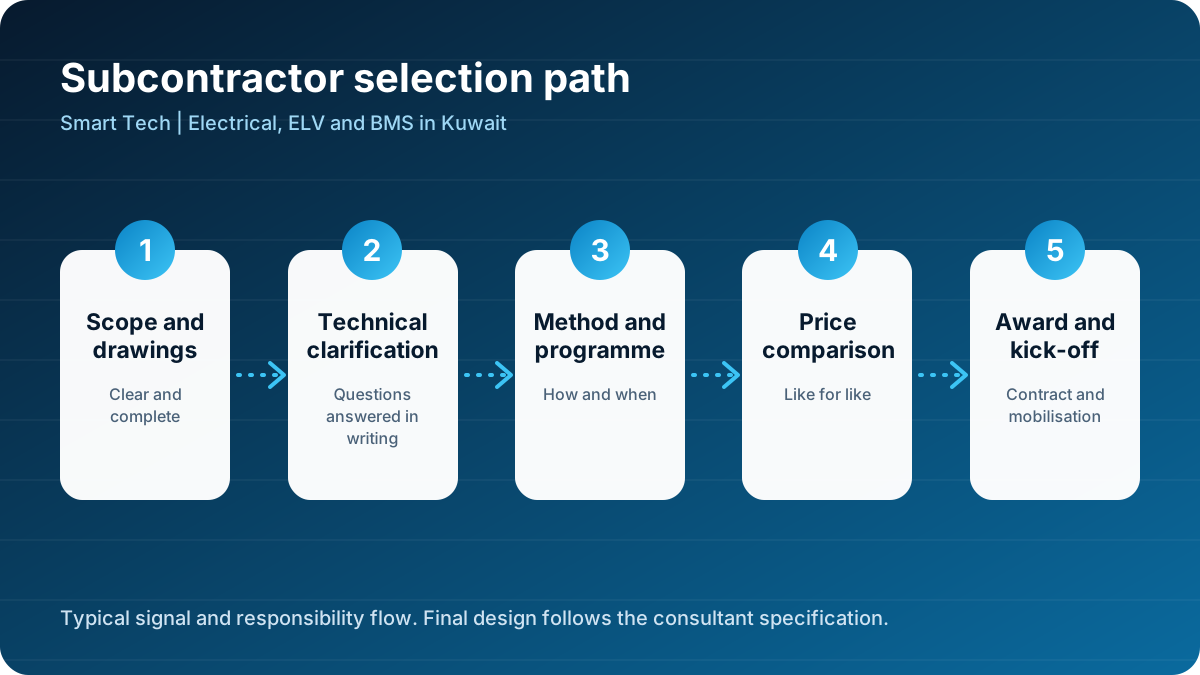
This guide gives main contractors, consultants and owners a practical way to evaluate electrical, ELV and BMS subcontractors in Kuwait. It follows the path of a real tender: define the scope, check the company, review the method, compare prices and agree the contract. It is written by a specialist subcontractor, so we know what a good bid looks like from the inside. You can learn more about us on our about page.
Step 1: Define the scope before you ask for prices
A tender is only as good as the information it contains. Before inviting bids:
- Issue a complete package: drawings, specification, bill of quantities, schedules and a programme.
- List the systems clearly: power distribution, lighting, low current, CCTV, fire alarm, access control, public address, BMS and so on. See the list of services we handle.
- Mark interfaces: who connects fire alarm to lifts and doors, who supplies network switches, who provides power to panels.
- State responsibilities for containment, cutting, fire stopping and making good.
- Include testing and documentation as deliverables with dates.
- Set the submission rules: format, deadline, validity of the offer and clarification process.
A short pre-tender meeting to explain the project removes many misunderstandings.
Step 2: Check the company, not just the price
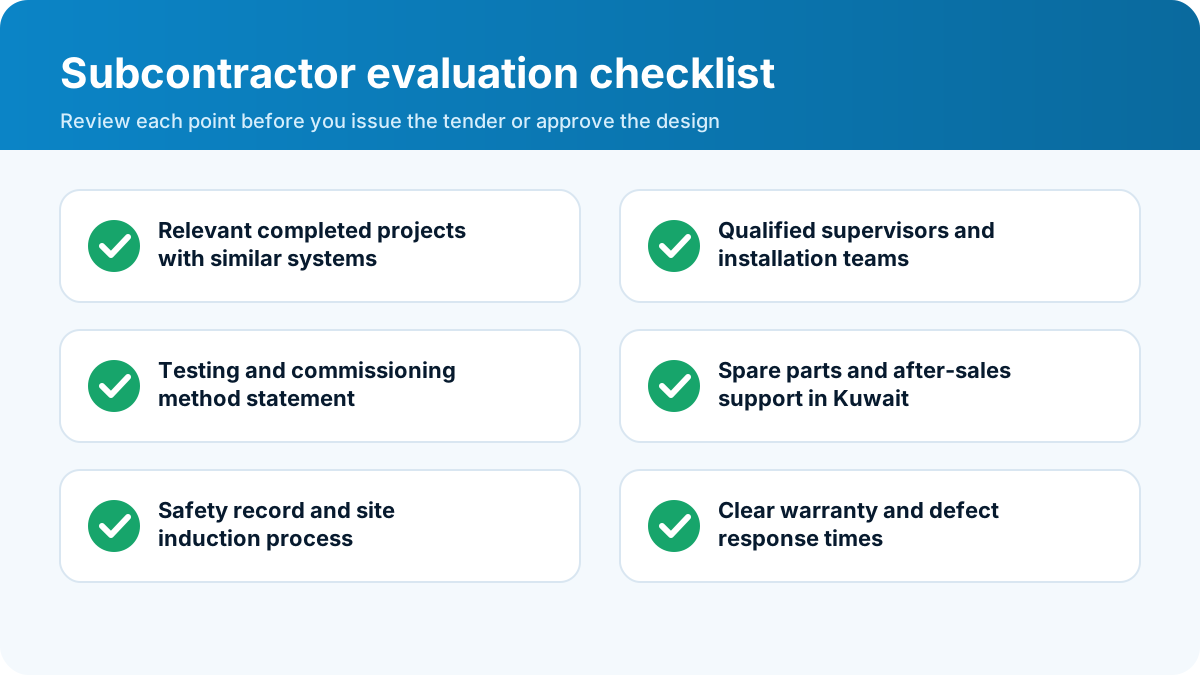
Experience that matches your project
A contractor who has installed hundreds of villa lighting systems may not be the right choice for an airport. Ask for projects of similar size, type and complexity, and check that the staff who delivered those projects are still with the company. You can review the types of work we have delivered on our projects page, including the Kuwait Stock Exchange and the Jazeera Airways terminal.
People
Ask for the names and CVs of the project manager, site engineer and supervisors who will be assigned. A strong company with the wrong team will deliver a weak result. Check qualifications, years of experience and whether they speak the languages needed on site.
Resources
Do they have enough technicians, tools, vehicles and storage for your programme? A contractor who bids on ten projects at once cannot staff all of them.
Financial health
Request recent financial information or references from suppliers. A subcontractor who cannot pay suppliers cannot deliver materials.
Safety and quality systems
Ask about the safety policy, training, incident record and quality procedures. See our own approach in quality and HSE. The ISO 9001 quality management and ISO 45001 occupational health and safety standards are widely recognised benchmarks, though certificates alone do not prove day-to-day practice.
Step 3: Review the technical proposal
A good technical proposal shows that the bidder has read your documents.
- Understanding of the project. Does the proposal reflect your drawings and risks, or is it generic?
- Method statement. How will the work be installed, tested and handed over?
- Programme. Is it realistic and tied to your milestones?
- Material proposals. Are brands and models named and equal to the specification? Are datasheets attached?
- Clarifications and exclusions. A clear list shows honesty. A long list may show a trap.
- Coordination approach. How will they handle clashes with other trades?

Step 4: Compare prices fairly
Normalise the offers
Create a comparison table with the same line items for each bidder, and note what is included or excluded.
| Item | Bidder A | Bidder B | Bidder C |
|---|---|---|---|
| Containment | Included | By others | Included |
| Testing and documentation | Included | Extra | Included |
| Authority submissions | Included | Excluded | Included |
| Training | 2 sessions | None | 1 session |
| Warranty | Stated | Not stated | Stated |
An offer that looks cheaper may become the most expensive once missing items are added.
Look for unrealistic prices
If one bid is far below the others, ask why. The bidder may have misunderstood the scope, or plan to recover cost through variations or reduced quality. A price that cannot cover material, labour, supervision and profit will not be delivered as promised.
Understand rates for variations
Ask for unit rates for additions and omissions. Fair, transparent rates make later changes easier to agree.
Step 5: Interview the proposed team
Meet the people who will manage the project. Useful questions include:
- Who will be on site every day?
- How do you plan to manage submissions and approvals?
- How do you manage material delivery and storage in Kuwait's climate?
- How do you test and document each system?
- What do you need from us to keep the programme?
- Tell us about a project that went wrong and what you learned.
The last question reveals honesty and maturity. A contractor who claims never to have had a problem is either inexperienced or not telling the truth.
Step 6: Check references
Call at least two references for each shortlisted bidder. Ask:
- Was the project completed on time and to the required quality?
- How did the company handle problems and changes?
- Were testing and handover documents complete?
- Would you hire them again?
- How is the system performing now?
Visiting a completed project, if possible, is more convincing than any brochure.
Step 7: Agree the contract terms
Clear terms protect everybody. Cover:
- Scope and inclusions referencing the drawings, specification and bill of quantities.
- Programme and milestones with agreed access dates.
- Payment schedule linked to measurable progress.
- Variation procedure with rates and approval steps.
- Testing, commissioning and handover requirements with documents listed.
- Warranty and defects with response times.
- Insurance and safety obligations.
- Dispute resolution process.
Contracts should be fair to both sides. A subcontractor who is squeezed on price and terms will protect itself in other ways.
A scorecard you can copy
Score each bidder from 1 to 5 on the following. Weight the categories to suit the project.
| Category | Suggested weight |
|---|---|
| Relevant experience and references | 20 percent |
| Team quality and availability | 15 percent |
| Technical proposal and method | 20 percent |
| Programme and resources | 10 percent |
| Safety and quality systems | 10 percent |
| Price (normalised) | 20 percent |
| After-sales support in Kuwait | 5 percent |
The scorecard turns a discussion into a record, and it makes your decision easy to explain.
Red flags to watch for
- No site visit or drawing review before bidding.
- Vague scope with generic text.
- Price far below the others with no explanation.
- Reluctance to name the team or give references.
- No testing and documentation in the price.
- Poor response to questions during the tender, which predicts poor response during the project.
- Claims of experience that cannot be verified.
- Pressure to sign quickly without clarifications.
Local presence matters
Kuwait's climate, traffic, approvals and supplier network all reward local knowledge. A subcontractor based in the country can inspect a problem the same day, hold stock of common parts and maintain relationships with suppliers and authorities. Our office is in Farwaniya, which allows quick access to projects across the governorates. See Farwaniya, Kuwait City, Hawalli and Salmiya, Al Ahmadi and Fahaheel, Al Jahra and Mubarak Al-Kabeer.
What a good subcontractor will ask you
The best bidders ask questions. If they never do, be careful. Expect questions about access, working hours, other trades, permits, water and power supplies, storage, programme dependencies and approval procedures. These questions show that they are thinking about delivery, not just winning the job.
Technical systems checklist
Before award, confirm the bidder's approach for each system in scope.
- Power distribution: panel design, short-circuit rating, testing. See power distribution and switchboards.
- ELV and data: cable category, rack rooms and test reports. See ELV systems guide and structured cabling.
- Fire alarm: approvals, device types and testing. See fire alarm systems.
- CCTV and access: camera schedule, storage, door schedule. See CCTV and access control.
- BMS: points list, protocols and sequences. See BMS in Kuwait.
- PA: zones and intelligibility. See public address and voice evacuation.
Managing the subcontractor after award
Choosing well is the start. Managing well finishes the job. A few habits make a large difference.
- Hold a kick-off meeting within the first week. Confirm the scope, programme, access dates, safety rules and contacts. Agree how drawings, submittals and requests for information will be handled.
- Review submittals quickly. Slow approvals are the most common reason a subcontractor's programme slips, and they are controlled by the client side.
- Hold weekly progress meetings. Compare planned and actual progress, list open issues and assign names and dates. Short, regular meetings prevent long, angry ones.
- Inspect work in stages. Look at containment before cables are pulled, cables before they are covered and panels before they are energised. Fixing a problem at the earliest stage is always cheaper.
- Record changes. Variations should be agreed in writing, with price and time effects, before work starts.
- Pay on time against progress. A well-paid subcontractor keeps a full crew on site.
- Keep the end in sight. Plan testing, training and documentation from the start and review them at every meeting.
Typical timelines to expect
Timelines vary with project size, but these ranges help set expectations. Design review and submittals for a mid-size commercial building often take several weeks, because materials must be approved before they are ordered. Lead times for panels, fire alarm equipment and BMS controllers can be several weeks or more. Installation then follows the building programme, with first fix before ceilings close and second fix after finishes. Testing and commissioning need a protected period at the end, and authority inspections add further time. A subcontractor who promises everything in half the normal time is either unusually well organised or not being realistic. Ask for a programme with durations, dependencies and the dates when they need access, drawings and approvals from you.
Risk sharing: who carries which risk
Every project has risks, and fair contracts place each one with the party best able to manage it. Design changes belong with the client side, so the subcontractor should be paid and given time when drawings change. Site access, power and water belong with the main contractor, so delays in these should extend the programme. Workmanship, supervision and the safety of the subcontractor's own staff belong with the subcontractor. Price changes in materials are harder: some contracts fix prices for a period and then allow adjustment for major movements. Whatever you choose, write it down. Most bitter disputes are not about money but about a risk that nobody realised they had accepted.
Small projects need the same discipline
Not every project is a tower. A clinic fit-out, a villa or a small warehouse can still go wrong for the same reasons: unclear scope, missing interfaces and no testing. For small jobs, a one-page scope sheet, a simple fixed price with named brands, a clear start and finish date and a list of documents at handover provide most of the protection. Ask the contractor to confirm in writing what is included, and who will be on site. A good small-project contractor is happy to do this, because it protects them too.
Request a proposal from us
If you are preparing a tender, send us the drawings and specification. Our engineers will review them, list their questions and submit a clear, itemised proposal that includes testing, documentation and training. Use our quote form or call +965-51133630.
Good subcontractors are not found by luck. They are chosen by clear scope, honest questions and attention to detail. Invest the time at tender stage, and the project will repay it many times.
Frequently asked questions
Should I always choose the lowest price?
No. The lowest price often leaves out testing, documentation, interfaces or supervision, which return later as variations or delays. Compare scope and quality first, then price.
How many subcontractors should I invite to tender?
Three to five qualified bidders is usually enough. More bidders increase effort without improving the result, and fewer reduce competition.
What documents should a subcontractor provide?
Company profile, relevant project references, key staff details, method statement, programme, safety plan, material submittals, insurance details and a priced bill of quantities.
How important is local presence in Kuwait?
Very important. Site supervision, quick response and after-sales support depend on being close to the project. Ask where the team and warehouse are based.
What warranty is reasonable?
The warranty period is set by the contract and the specification. Compare not only the length of the warranty but also how quickly defects are fixed and who is responsible for each item.